Introduction to redstone
Содержание:
История
| Альфа-версия Java Edition | ||
|---|---|---|
| 1.0.1 | Красная пыль добавлена в игру. Имеет название «Red Ore Dust» (рус. Пыль красной руды). | |
| 1.0.4 | Переименована в «Redstone» (рус. Красный камень). | |
| Бета-версия Java Edition | ||
| 1.5 | Красная пыль может быть установлена на снег. | |
| 1.6.6 | Красная пыль может быть размещена на светокамне. | |
| 1.7 | Не считая огня, красная пыль сегодня единственный способ зажечь ТНТ. | |
| Официальный выпуск Java Edition | ||
| 1.0.0 | Beta 1.9 Prerelease | Снегопад теперь может уничтожить красную пыль. |
| RC1 | Изменена форма красной пыли, размещенной на одном блоке с на . | |
| 1.1 | Заборы могут быть открыты и закрыты с помощью сигнала красной пыли. | |
| 1.3.1 | 12w21a | Красная пыль стала возобновляемой при помощи торговли. |
| 12w25a | Красная пыль может быть установлена на верхнюю и нижнюю стороны полублоков и лестниц. | |
| 1.4.2 | 12w38a | Добавлены ведьмы, при смерти которых иногда выпадает красная пыль. |
| 1.5 | 13w01a | Красная пыль может быть использована для крафта блока красного камня и выбрасывателя. |
| 1.7.2 | 13w37a | Удалён красный провод в виде блока. |
| 1.16 | 20w06a | Красная пыль теперь имеет нижнюю текстуру. |
| 20w18a | Теперь одиночная красная пыль будет отображаться не точкой, а крестом, направленным во все 4 стороны. | |
| Предметы, такие как люк, дверь или калитка будут открываться, если под ними есть активированная красная пыль. | ||
| 20w21a | При нажатии ПКМ на изолированную красную пыль она меняет форму между крестом и точкой. Красная пыль в виде точки не передаёт энергию окружающим объектам, а крест — передаёт. Соединённая с чем-нибудь красная пыль является непереключаемой. | |
| 0.8.0 | Красная пыль добавлена в игру. | |
| Выпадает при добыче красной руды. | ||
| 0.11.0 | build 1 | Красная пыль используется для крафта блока красного камня. |
| 0.13.0 | build 1 | Красная пыль может быть установлена. |
Usage[]
A redstone lamp can be used to produce switchable light.
Redstone lamps are and can be activated by:
- An adjacent active power component, including above or below: for example, a redstone torch (except that a redstone torch does not activate a redstone lamp it is attached to), a block of redstone, a daylight sensor, etc.
- An adjacent powered block (for example, an opaque block with an active redstone torch under it), including above or below
- A powered redstone comparator or redstone repeater facing the redstone lamp
- Adjacent powered configured to point at the redstone lamp (or on top of it) or directionless; a redstone lamp is not activated by adjacent powered redstone dust that is configured to point away from it.
A redstone lamp activates instantly, but takes 2 redstone ticks to turn off (4 game ticks, or 0.2 seconds barring lag).
An active redstone lamp produces block light 15. An inactive redstone lamp produces no light.
A redstone lamp acts like an opaque block; it blocks sky light, mobs suffocate in it, and it conducts redstone power.
Describing Circuits[]
Most circuits are described using Schematic diagrams; some of these require multiple images to show one or two layers per image. See the Help:Schematic page for details on how various blocks and components are represented.
Size
The wiki describes circuit size (the volume of the rectangular solid it occupies) with the notation of shorter width × longer width × height, including support/floor blocks, but not including inputs/outputs.
Another method used for describing circuit size in the Minecraft community is to ignore non-Redstone blocks simply used for support (for example, blocks under Redstone dust or repeaters). However, this method is unable to distinguish between and circuits, as well as some other circuit differences.
Sometimes it is convenient to compare circuits simply by the area of their footprint (e.g., 3×4 for a circuit three-block wide by four blocks long), or by a single dimension important in a particular context (e.g., length in a sequence of sub-circuits, height in a confined space, etc.).
Features
Several features may be considered desirable design goals:
- 1-high
- A structure is 1-high (aka «1-tall») if its vertical dimension is one block high (meaning it cannot have any redstone components that require support blocks below them, such as redstone dust or repeaters). Also see .
- 1-wide
- A structure is 1-wide if at least one of its horizontal dimensions is exactly one block wide.
- Flat
- A structure is flat if it generally can be laid out on the ground with no components above another (support blocks under redstone components are okay). Flat structures are often easier for beginners to understand and build, and fit nicely under floors or on top of roofs. Also see .
- Flush
- A structure is flush if it doesn’t extend beyond a flat wall, floor, or ceiling and can still provide utility to the other side, though redstone mechanisms may be visible in the wall. Flush is a desirable design goal for piston-extenders, piston doors, etc. Also see and .
- Hipster
- A structure is hipster if it is initially hidden behind a flat wall, floor, or ceiling and can still provide utility to the other side. See also and .
- Instant
- A structure is instant if its output responds immediately to its input (a circuit delay of 0 ticks).
- Seamless
- A structure is seamless if no redstone components are visible both before and after it completes its task (but it’s okay if some are visible during operation). Seamless is a desirable design goal for piston-extenders, piston doors, etc. See also and .
- Silent
- A structure is silent if it makes no noise (such as from piston movement, dispenser/dropper triggering when empty, etc.). Silent structures are desirable for traps or peaceful homes.
- Stackable
- A structure is stackable if it can be placed directly next to other copies of itself, and they all can be controlled as a single unit. Also see .
- Tileable
- A structure is tileable if it can be placed directly next to other copies of itself, and each copy can still be controlled independently. Also see .
- Structures might be described as «2-wide tileable» (tileable every two spaces in one dimension), or «2×4 tileable» (tileable in two directions), etc. Some structures might be described as «alternating tileable», meaning they can be placed next to each other if every other one is flipped or a slightly different design.
Other design goals may include reducing the delay a sub-circuit adds to a larger circuit, reducing the use of resource-expensive components (redstone, nether quartz, etc.), and re-arranging or redesigning a circuit to make it as small as possible.
Some components are not available before a player has access to the Nether, which limits the designs available. In particular, redstone comparators, observers and daylight detectors require nether quartz, which is available only from the Nether. Additionally, redstone lamps require glowstone, which is occasionally available from trading or witches, but is much more plentiful in the Nether.
Физические свойства
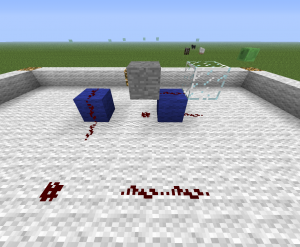
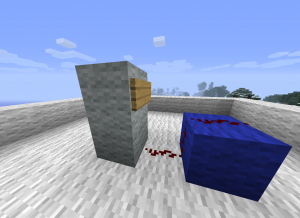
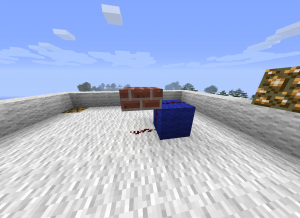
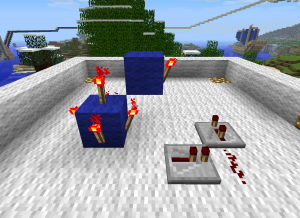
Красная пыль при установке в игровом мире представлена в виде красного провода — нетвёрдого блока, который можно ставить только на верх других блоков, причем они должны быть полными и непрозрачными. Красный провод разрушается с одного удара или попадания жидкости, его можно подобрать и снова установить. Два рядом находящихся участка красного провода объединяются в цепь. Цепи можно как угодно разветвлять и соединять.
Два участка красной пыли, расположенных на соседних блоках, которые различаются по высоте на 1, объединятся в непрерывный участок провода. Но, если поставить между ними полный блок, объединения не произойдет. Неполные блоки (например, таблички и плиты) не мешают соединению. Грядка тоже не мешает соединению, а вот затоптанная земля — мешает. Есть два особых случая: стекло, в отличие от остальных полных блоков, не препятствует объединению и прохождению сигнала, в то время как светящийся камень визуально разделяет провод, но сигнал все равно может пройти.
Красный факел по физическим свойствам практически идентичен обычному — он может быть установлен сверху или сбоку любого полного непрозрачного блока. Единственное отличие заключается в яркости излучаемого света — 7 против 14.
Красный повторитель, в отличие от проводов и факелов, твёрдый блок.
Провода не излучают свет (только меняют текстуру), а свет факелов и повторителей недостаточен для препятствия спауну , будьте осторожны и следите за освещением.
Изменения[]
Основная статья: 1.5
Изменения красного камня
- Более предсказуемое и последовательное поведение красного камня.
- Детекторы обновления блоков частично исправлены.
- Большинство таймингов механизмов из красного камня изменились.
- В общем красный камень больше похож по функциональности на аналоговые сигналы.
-
Компаратор.
- Похожее на повторитель устройство, позволяющее сравнивать силу двух сигналов.
- Послужил заменой первоначально запланированному конденсатору.
- Загрузочная воронка, способная помещать предметы в контейнеры.
-
Утяжелённые нажимные пластины
Вывод сигнала с силой, соответствующей весу объекта (например, вагонетки с сундуком), стоящего на нажимных рельсах.
, регистрирующие давление — сила сигнала на выходе зависит от давления.
-
Датчик дневного света
Вывод сигнала с силой, соответствующей интенсивности солнечного света.
.
- Сундук-ловушка, подающий сигнал при открытии.
- Выбрасыватель – механизм, подобный раздатчику, но никогда не использует предметы по назначению, а только выбрасывает их.
- Улучшение раздатчиков
- Надевает броню на игроков.
- Установка и активация ТНТ.
- Использовать костную муку на грядке и саженцах.
- Можно зажечь огонь с помощью огнива, которое расходуется.
- Улучшения заблокированного повторителя.
- Некоторые исправления красного камня.
-
Кварцевая руда Нижнего мира, из которой выпадает кварц
Кварцевый блок.
.
Улучшения вагонеток
- Вагонетка с ТНТ.
- Вагонетка с воронкой.
- Вагонетка со спаунером.
- Новый вид рельс — активирующие рельсы (служат активатором для вагонетки с ТНТ)
- Возможность заполнения и опустошения вагонеток с сундуком.
Переработка движка
- Текущий движок имеет некоторые ошибки
- Потребует OpenGL
Будет включать какой-то обходной путь для старого оборудования
с высоким набором функций
- Поддержка текстур высокого разрешения
- Внутренняя планировка пакетов текстур изменится
- Каждый блок будет иметь свой собственный файл текстуры
- Текстур-паки будут автоматически конвертированы в нужный формат
- Поддерживает использование анимированных текстур для всех блоков
- Геометрия отдельных текстур может отличаться
- Не предназначено для поддержки HD скинов
- Внутренняя планировка пакетов текстур изменится
- Гораздо более быстрый общий рендеринг, в результате чего больше FPS («кадров в секунду»).
- Исправления освещения, похожие на те, что были впервые введены в снимках 12w39a/b (в течение развития 1.4). Особенностями являются:
- Поддержка мощного управления освещением
- Исправление случайного появления черных областей
- Поддержка более реалистичного освещения, например, активная печь испускает свет только передней частью
History[]
| Java Edition | |||||
|---|---|---|---|---|---|
| 1.5 | 13w01a | Added blocks of redstone. | |||
| The unused locked chest texture has been changed to have a block of redstone texture on the side, due to the redstone block taking up its texture space. | |||||
| 1.8 | 14w02a | Mobs now suffocate inside of the redstone block. | |||
| 1.13 | 17w47a | Prior to The Flattening, this block’s numeral ID was 152. | |||
| 1.14 | 18w43a | The texture of blocks of redstone has now been changed. | |||
| 1.16 | 20w10a | Blocks of redstone can now support ladders and tripwire hooks. | |||
| Pocket Edition Alpha | |||||
| v0.11.0 | build 1 | Added blocks of redstone. | |||
| The only purpose of blocks of redstone is to store redstone dust. | |||||
| v0.13.0 | build 1 | Redstone blocks now have an unspecified proper purpose. | |||
| Bedrock Edition | |||||
| 1.10.0 | beta 1.10.0.3 | The texture of blocks of redstone has now been changed. | |||
| Legacy Console Edition | |||||
| TU19 | CU7 | Patch 1 | 1.0.1 | Added blocks of redstone. | |
| The texture of blocks of redstone has now been changed. | |||||
| New Nintendo 3DS Edition | |||||
| 0.1.0 | Added blocks of redstone. |
Obtaining[]
Mining
See also:
Redstone ore mined using an iron pickaxe or higher drops 4 or 5 redstone dust (or more with Fortune, averaging at 6 redstone dust with Fortune level 3). If mined with Silk Touch, the block drops itself instead of redstone dust.
Natural generation
15 lengths of redstone dust are naturally generated as part of the trap in each jungle pyramid. 5 lengths of redstone dust can be found in one type of jail cell room in a woodland mansion.
Breaking
Redstone dust can be broken instantly using any tool, or without a tool, and drops itself as an item.
Redstone dust is removed and drops as an item if:
- its attachment block is moved, removed, or destroyed
- water or lava flows into its space
- a piston tries to push it or moves a block into its space
Mob loot
Witches have a chance of dropping 0–2 redstone dust upon death. This is increased by 1 per level of Looting, for a maximum of 0–5 redstone dust.
Chest loot
| Item | Structure | Container | Quantity | Chance |
|---|---|---|---|---|
| Java Edition | ||||
| Redstone Dust | Dungeon | Chest | 1–4 | 26.6% |
| Mineshaft | Chest | 4–9 | 14.5% | |
| Stronghold | Storeroom chest | 4–9 | 18.6% | |
| Altar chest | 4–9 | 12.1% | ||
| Village | Temple chest | 1–4 | 44.8% | |
| Woodland mansion | Chest | 1–4 | 26.6% | |
| Java Edition 1.18[] | ||||
| Redstone Dust | Stronghold | Altar chest | 4–9 | 12% |
| Bedrock Edition | ||||
| Redstone Dust | Dungeon | Chest | 1–4 | 26.6% |
| Mineshaft | Chest | 4–9 | 14.5% | |
| Stronghold | Storeroom chest | 4–9 | 15.2% | |
| Altar chest | 4–9 | 11.8% | ||
| Village | Temple chest | 1–4 | 44.8% | |
| Woodland mansion | Chest | 1–4 | 26.6% |
Redstone dust can be crafted from blocks of redstone.
| Ingredients | Crafting recipe |
|---|---|
| Block of Redstone | 9 |
Trading
In Java Edition, novice-level cleric villagers sell two redstone dust for one emerald.
Clerics may give redstone dust to a player with the Hero of the Village effect.[Java Edition only]
In Bedrock Edition, novice-level cleric villagers sell four redstone dust for one emerald.
Transmitting power: Redstone wire
The final piece of the puzzle is redstone wire, which is made by placing redstone dust on the floor. The dust will connect up to make a wire, and will even go up and down steps.
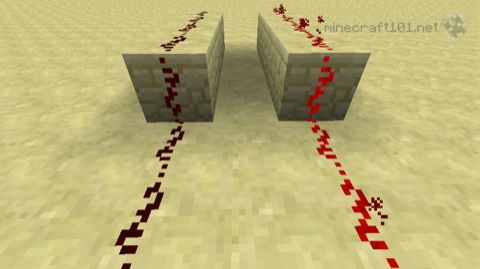
Redstone wire: when it’s powered, as on the right, it lights up and sparkles.
Redstone wire is used to transmit power from place to place, just like electrical wire. Redstone wire becomes powered when it is adjacent to a powered block, for example a block containing a power source, or the block a lever is attached to, or the block above a redstone torch.
Redstone power runs along the redstone wire, powering the blocks underneath the wire.
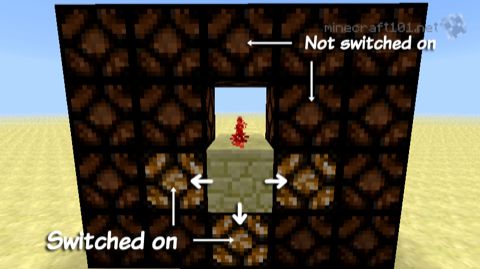
Note that it is the block underneath the redstone wire that is powered (and switches on its neighbours), not the block containing the redstone wire.
Redstone wire also powers the block at the end of the line; however, this block only gets weak power. A block at the end of a redstone wire will switch on neighbouring blocks like any other powered block, but it will not power redstone wire in them.
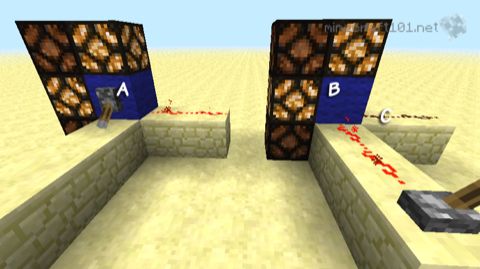
The blue block marked ‘A’ is powered directly by the lever: it switches on the neighbouring blocks, including devices and redstone wire. Block B is at the end of a redstone wire and is weakly powered: it can activate devices (the lamps) but the redstone wire marked C is NOT switched on.
How far does the power travel?
Redstone power will travel a certain distance along a wire, depending on the strength of the power source.
Most power sources have a strength of 15, meaning the power will go 1 blocks. Certain power sources such as daylight sensors or weighted pressure plates might produce less power, which will travel a shorter distance.
Sending power vertically
Redstone power can go up and down stairs. The most compact form is a spiral that fits in a 2×2 column: you can go up and down these stairs too!
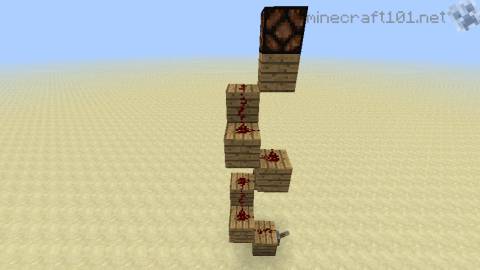
You’ll need to add a repeater every 15 blocks to keep the current flowing.
Redstone Ladders
Certain blocks are ‘not quite solid’ and can be used to build a more compact ladder for redstone current, but it will only travel in an upward direction. These blocks are upside-down stairs, slabs placed in the top half of the block, and glowstone.
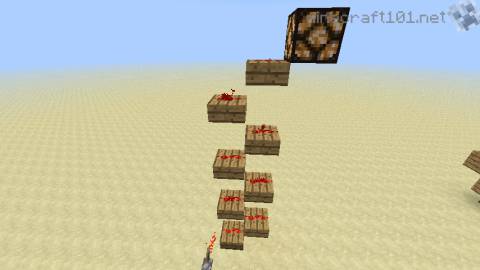
Redstone Torch Ladders
Redstone torches can be used to create ladders that move a signal up or down.
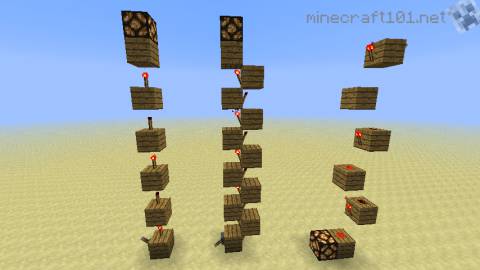
Redstone torches switch off if the block they are attached to is powered, which is how these ladders work. This means that torches in the ladder alternate between ON and OFF. There are three designs above: the first two transmit signals upwards. The second transmits signals downwards: note the redstone dust on top of each bloch; that’s important.
Extending the range: Redstone repeaters
Redstone repeaters have three functions:
- they extend the range of a wire, boosting the signal to a strength of 15. By playing a repeater every 15 blocks you can extend a wire as far as you want.
- they introduce a small delay into the wire; you can set how long by right clicking to cycle between 0.1, 0.2, 0.3 or 0.4 seconds.
- they only allow redstone current to pass in one direction (marked by an arrow on top of the repeater), like a diode.
This last function means that redstone repeaters are handy if you want to place parallel wires close together without them joining up.
Another use for repeaters is if you want the block at the end of a redstone wire to receive strong power, not weak.
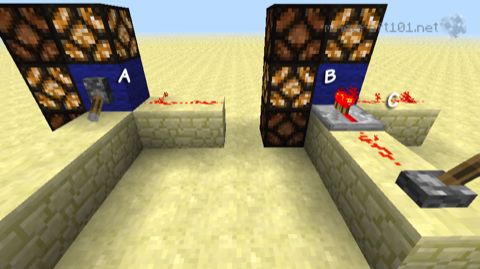
Remember this picture from just up the page? Now the redstone wire powering block B has a repeater at the end, and is getting strong power: enough to allow it to activate the redstone wire (C) as well as the lamps.
A redstone repeater is crafted from smooth stone blocks (not cobblestone), redstone dust and redstone torches.
Історія
| Java Edition Alpha | ||
|---|---|---|
| 1.0.1 | Додано «Пил червоної руди» (предмет) і редстоун пил (блок) | |
| 1.0.2_01 | Редстоун пил тепер не підключається через тверді блоки по діагоналі вниз | |
| 1.0.4 | Перейменовано на «Редстоун». | |
| Java Edition Beta | ||
| 1.3 | Чим далі редстоун пил від джерела енергії тим темнішим він стає. | |
| 1.5 | Редстоун пил може бути розміщено на снігу. | |
| 1.6.6 | Змінено матеріал світлокаменю з «скло» на «камінь», що дозволило розміщати редстоун пил на нього. | |
| 1.7 | Redstone dust now will connect to a repeater without the dust being explicitly pointed at it. | |
| Крім вогню редстоун тепер єдиний спосіб активувати динаміт. | ||
| 1.7.3 | Pistons connected to the end of a piston transistor via redstone are now properly closed when the power goes out. | |
| Java Edition | ||
| 1.0.0 | Beta 1.9-pre1 | Снігопад тепер може знищувати редстоун пил. |
| 1.0.0-RC1 | Змінено вигляд одиночного редстоун пилу з «+» на «•». | |
| 1.1 | Хвіртку тепер можна відкривати за допомогою редстоун пилу. | |
| 1.3.1 | 12w21a | Редстоун тепер можна отримати за допомогою торгівлі. |
| 12w25a | Редстоун пил тепер можна розмістити на верхній частині перевернутих плит і сходів. | |
| 1.4.2 | 12w38a | Додано відьми. З них інколи випадає редстоун. |
| 1.5 | 13w01a | Редстоун використовується у крафті Блоку редстоуну і викидача. |
| 1.8 | 14w25a | Глюк «Безкінечний обсидіан» (дозволяв перетворювати Редстоун в обсидіан) виправляється в ході реалізації нового формату блоку метаданих |
| 0.8.0 | build 2 | Редстоун тепер випадає при видобутку руди редстоуну. |
| Legacy Console Edition | ||
| Додано редстоун. | ||
| Redstone dust now will connect to a repeater without the dust being explicitly pointed at it. |
Sounds[]
Generic
Java Edition:
| Sound | Subtitles | Source | Description | Resource location | Translation key | Volume | Pitch | Attenuationdistance |
|---|---|---|---|---|---|---|---|---|
| Block broken | Blocks | Once the block has broken | 1.0 | 0.8 | 16 | |||
| None | Blocks | Falling on the block with fall damage | None | 0.5 | 0.75 | 16 | ||
| Block breaking | Blocks | While the block is in the process of being broken | 0.25 | 0.5 | 16 | |||
| Block placed | Blocks | When the block is placed | 1.0 | 0.8 | 16 | |||
| Footsteps | Blocks | Walking on the block | 0.15 | 1.0 | 16 |
- ↑
Bedrock Edition:
| Sound | Source | Description | Resource location | Volume | Pitch |
|---|---|---|---|---|---|
| Blocks | Once the block has broken | 1.0 | 0.8 | ||
| Blocks | Falling on the block with fall damage | 0.4 | 1.0 | ||
| Blocks | While the block is in the process of being broken | 0.37 | 0.5 | ||
| ? | Blocks | Jumping from the block | 0.12 | 1.0 | |
| ? | Blocks | Falling on the block without fall damage | 0.22 | 1.0 | |
| Blocks | Walking on the block | 0.3 | 1.0 | ||
| Blocks | When the block is placed | 1.0 | 0.8 |
Unique
Java Edition:
| Sound | Subtitles | Source | Description | Resource location | Translation key | Volume | Pitch | Attenuationdistance |
|---|---|---|---|---|---|---|---|---|
| Stonecutter used | Blocks | Plays when taking output | ? | 1 | 0.92, ? | 16 |
Основные устройства и элементы
| Ингредиенты | Рецепты крафта | Результат | Описание |
|---|---|---|---|
| Светопыль +Красная пыль +Жемчуг Края | REther жемчуг | ||
| Обсидиан | Обсидиановая палка | ||
| REther жемчуг +Обсидиановая палка | Беспроводной приемопередатчик | Главный компонент основных приёмо-передающих устройств модификации. | |
| Огненный стержень +REther жемчуг | Пламенный приемопередатчик | Компонент крафта дополнительных устройств. | |
| Камень | Каменная миска | ||
| Каменная миска +Беспроводной приемопередатчик | Миска с приёмником | ||
| Каменная миска +Пламенный приемопередатчик | Миска с пламенным приёмником | ||
| Красная пыль +Беспроводной приемопередатчик +Каменная плита +Обсидиановая палка | Беспроводной передатчик | Устройство беспроводной передачи сигнала.При подаче сигнала красного камня транслирует его всем приёмникам, работающим на выбранной частоте.Частота настраивается по нажатию ПКМ на устройстве. | |
| Красная пыль +Каменная плита +Обсидиановая палка +Миска с приёмником | Беспроводной приёмник | Устройство беспроводного приема сигнала.Принимает сигнал, транслированный на выбранной частоте, и передает его подключенным устройствам как сигнал красного камня.Частота настраивается по нажатию ПКМ на устройстве. |
Что делают компоненты Redstone в Minecraft?

Это основные компоненты красного камня, которые вы найдете в игре, и краткое описание того, что каждый из них делает.
Источники энергии Redstone
Источники питания — это блоки, которые автоматически излучают сигнал мощности красного камня . Некоторые из них сильнее других, и со многими из них нужно взаимодействовать, чтобы сигнал был включен.
Факел из красного камня

Самый простой источник энергии , они предоставят уровень мощности 15 любым блокам, с которыми они соприкасаются.
Размещение факела из красного камня очень важно. Факел не будет приводить в действие блок, к которому он непосредственно прикреплен , но будет приводить в действие кучу блоков вокруг него
Его сила сигнала с пылью красного камня составляет 15 блоков до того, как сигнал умрет.
Блок красного камня

Полный блок из красного камня даст сигнал мощностью 15 блоков при подключении к пыли из красного камня.
Он также активирует любые устройства и блоки, которые непосредственно примыкают к одной из его шести сторон.
Кнопка

Кнопки выдают одиночный импульс сигнала красного камня, когда они прикреплены к проводке из красного камня.
Сигнал проходит 15 блоков и активирует любые устройства на своем пути. Кнопки также приводят в действие блок, к которому они прикреплены , а также несколько блоков вокруг них.
Поскольку кнопка считается блоком , блоки, расположенные напротив нее, сверху или снизу, также будут получать питание.
Рычаг

Рычаги имеют тот же диапазон, что и кнопки, при использовании в проводке, то есть 15 блоков. Они издают непрерывный сигнал при однократном нажатии на рычаг и могут быть выключены при повторном нажатии.
Рычаг приводит в действие блоки вокруг него так же, как и кнопка, поэтому любой блок, к которому он прикреплен, будет получать питание, так же как и все вокруг него.
Пластины давления

Обычные деревянные и каменные нажимные пластины , когда игрок наступает на них, посылают сигнал 15 блоков. Каменные будут обнаруживать только пассивных мобов, враждебных мобов и игроков , но не предметы. Они также активируют блоки рядом с ними, а также непосредственно под ними.
У утяжеленных нажимных пластин будет более сильный сигнал, чем больше на них набито сущностей , будь то мобы или предметы, брошенные на землю. Для активации тяжеловесных нажимных пластин требуется 10 объектов.
Наблюдатель

Это похожее на лицо устройство делает именно то, что подразумевает его название: оно наблюдает за любым блоком, помещенным перед ним. Когда блок перед ним меняется, наблюдатель посылает быстрый импульс сигнала красного камня максимум на 15 блоков по проводу для пыли красного камня.
Наблюдатель также активирует блоки прямо за ним.
Датчик дневного света

Полезность этого блока тоже в его названии. Он обнаруживает дневные и ночные циклы и на основе этого посылает сигнал красного камня.
Вы можете выбрать дневной или ночной режим, щелкнув правой кнопкой мыши датчик дневного света . Дневной режим излучает десятиблочный сигнал красного камня через проводку из красного камня, когда он днем, а ночной режим делает то же самое, но ночью. Когда он активен, он активирует блоки непосредственно вокруг себя.
натяжными

Отлично подходит для изготовления ловушек и тому подобного, когда игрок наступает на веревку, подвешенную между двумя крючками, она посылает сигнал красного камня на 15 блоков, в то время как игрок или моб стоит на вершине проволоки.
Сигнал умирает, когда игрок или моб выходит из ловушки. Tripwire также активирует блоки непосредственно в непосредственной близости от крюка Tripwire.
Сундук-ловушка

Еще один отличный инструмент для ловушек и розыгрышей, сундук-ловушка активирует любой блок или проводку в пределах своего прямого диапазона.
Сигнал очень слабый, длится только один блок, поэтому вы можете использовать несколько дополнительных повторителей для более сложных ловушек.
Детекторный рельс

Этот специальный кусок шины будет посылать сигнал красного камня мощностью 15 блоков по проводке и питать любые блоки в пределах своего прямого диапазона .
Если вы хотите построить систему вагонеток, это обязательный компонент.
Компаратор

Компараторы, вероятно, являются самым сложным компонентом для понимания . По сути, они не имеют сигнала красного камня, но скорее будут выводить тот же сигнал, что и в них .
Компараторы имеют два режима: нормальный (свет спереди не горит) и вычитающий (свет спереди горит).

Нормальный режим: если сигнал, поступающий в компаратор сбоку, сильнее, чем сигнал, идущий обратно, то выходной сигнал будет отключен.
Режим вычитания: мощность сигнала сбоку вычитается из мощности сигнала сзади. Полученная сила затем выводится спереди.
History[]
| Java Edition pre-Classic | |||||
|---|---|---|---|---|---|
| rd-131655 | Added stone. | ||||
| Stone, along with grass, is one of the first two blocks in Minecraft. This can be seen by its position in terrain.png and numeric block ID of 1. | |||||
| The texture of stone is from one of Notch’s previous games, RubyDung. | |||||
| rd-20090515 | Stone’s texture has been overhauled. | ||||
| The old texture used for stone is recycled and modified for use by cobblestone. | |||||
| Java Edition Classic | |||||
| 0.26 SURVIVAL TEST | Creeper explosions no longer destroy stone or stone-like blocks. | ||||
| Mining stone now drops cobblestone. | |||||
| Java Edition Indev | |||||
| 0.31 | 20100201-2 | A pickaxe is now required to mine stone. | |||
| Stone can also be mined by hands other than the pickaxe. | |||||
| A pickaxe is now required to mine stone once again. | |||||
| Cobblestone is now smeltable into normal stone. | |||||
| Java Edition Infdev | |||||
| 20100617-2 | As cobblestone can be generated using water and lava, stone has become a renewable resource. | ||||
| Java Edition Alpha | |||||
| v1.0.1 | Stone can now be used to craft stone pressure plates (3 stone in slab fashion) and stone buttons (2 stone in the stick shape). | ||||
| Java Edition Beta | |||||
| 1.3 | The stone slab recipe now uses 3 stone instead of cobblestone. | ||||
| The stone pressure plate recipe now requires 2 stone instead of 3. | |||||
| Stone can now be used to craft redstone repeaters. | |||||
| 1.8 | Pre-release | Stone can now be crafted into stone bricks. | |||
| Java Edition | |||||
| 1.0.0 | Beta 1.9 Prerelease | Stone can now be made by having lava flow on top of water. In previous versions, the lava would replace the water and continue falling. | |||
| Beta 1.9 Prerelease 5 | The texture of stone has been changed slightly. | ||||
| 1.4.2 | 12w34b | Stone buttons are now crafted with only one stone. | |||
| 12w38a | Stone blocks have been given new sounds for being walked on and mined. | ||||
| 1.5 | 13w01a | Stone can now be used to craft redstone comparators. | |||
| Stone can now be used to craft hoppers. | |||||
| 13w02a | Stone is no longer used to craft hoppers. | ||||
| 14w27b | Stone textures are now randomly mirrored and rotated 180 degrees, making large areas of stone look less uniform. | ||||
| 1.14 | 18w43a | Stone can now be smelted into smooth stone. | |||
| The texture of stone has been changed. | |||||
| 18w44a | The texture of stone has been changed, once again. | ||||
| 18w49a | Stone can now be found in chests in village mason houses. | ||||
| 19w04a | Stone can now be used to craft stonecutters. | ||||
| 19w11a | Stone is now bought by villagers of the new mason profession. | ||||
| Pocket Edition Alpha | |||||
| Pre-release | Added stone. | ||||
| v0.2.0 | The texture of stone has been changed. | ||||
| v0.3.0 | Stone can now be used to craft stone slabs. | ||||
| v0.4.0 | Stone can now be used to craft stone bricks. | ||||
| v0.9.0 | build 1 | Added three new stone variants: granite, diorite and andesite, as well as polished versions for each. | |||
| v0.12.1 | build 1 | Stone can now be obtained using pickaxes with the Silk Touch enchantment. | |||
| v0.13.0 | build 1 | Stone can now be used to craft stone buttons and pressure plates. | |||
| v0.14.0 | build 1 | Stone can now be used to craft redstone repeaters and redstone comparators. | |||
| Bedrock Edition | |||||
| 1.9.0 | beta 1.9.0.0 | Stone can now be smelted into smooth stone. | |||
| Stone is now used to craft stone slabs and stairs. | |||||
| 1.10.0 | beta 1.10.0.3 | Stone can now be used to craft grindstones and stonecutters. | |||
| Stone mason villagers now buy 20-26 stone as part of their second tier trades. | |||||
| The texture of stone has been changed. | |||||
| 1.11.0 | beta 1.11.0.1 | Stone can now be found in village mason chests. | |||
| beta 1.11.0.4 | Trading has been changed, apprentice-level stone mason villagers now buy 20 stone as part of their trades. | ||||
| 1.17.0 | beta 1.17.0.52 | Stone is no longer used to repair stone tools and weapons on an Anvil. | |||
| Legacy Console Edition | |||||
| TU1 | CU1 | Patch 1 | 1.0.1 | [verify] Added stone. | |
| The texture of stone has been changed. | |||||
| New Nintendo 3DS Edition | |||||
| 0.1.0 | Added stone. |
Data history
| Java Edition | |||||||||||||||||||||||||||
|---|---|---|---|---|---|---|---|---|---|---|---|---|---|---|---|---|---|---|---|---|---|---|---|---|---|---|---|
| 1.8 | 14w02a | The newly-implemented granite, andesite and diorite, as well as the polished versions for each, use stone’s ID and are distinguished using metadata. | |||||||||||||||||||||||||
| 14w10a | Stone with numerical metadata variants 7 through 15, which are inaccessible through normal gameplay, now have no model rather than appearing identical to stone. | ||||||||||||||||||||||||||
| 14w25a | Stone and its variants are now defined via block states rather than by numerical metadata. Prior to this version, the numerical metadata variants of stone were as follows:
|
||||||||||||||||||||||||||
| 14w26a | Stone with metadata values 7 through 15 have now been completely removed from the game. | ||||||||||||||||||||||||||
| 1.13 | 17w47a | The different block states for the ID have been split up into their own IDs. | |||||||||||||||||||||||||
| Prior to The Flattening, this block’s numeral ID was 1. |